Labels

tasting notes (39) brewing (35) beer review (26) yeast (16) hops (12) breweries (10) Beer Geek Night (9) malt (6) beer names (5) brewing gear (4) festival (2) MtG (1) games (1) macro (1)
Posts tonen met het label Beer Geek Night. Alle posts tonen

maandag 9 december 2013

Beer Geek Night and another Beer Geek Night. Oh and the Ouzo effect!

So much to do, and so little time to do it in...


Apologies, Constant Reader! It turns out I've a couple of undocumented beery incidents on my drive, accumulating cyberdust and feeling a bit forlorn.
What with all the brewing and contemplating beery things all day, I've a bunch of beer related events to cover, two of which are  Beer Geek Nights. So, enough of the apologetic preamble already, onward! For science!

Beer Geek Night #3 was a bit of a pot luck afair, with all attendees adding something to the pile of science to be assessed.
First beer of the evening was Vinken Blond:


Turns out fellow Beer Geek Johan's grandfather used to brew this beer back in (ahem) 1866, and apparently, the village of Geistingen thought it time to resurrect it. A beer with a bit of history and family folklore, I like that. However, much as I'd feared, Vinken Blond is a rather generic and interchangeable Belgian blond, which fails to stand out amidst the hectoliters of comparable blond beers available all over the country. Historic or not, Vinken Blond never makes a mark, and fades into the background of easy, commonplace blond flavours. Nice, don't get me wrong, but most of my sympathy vote is derived from the history behind the beer, rather than the organoleptic experience it evokes.

Next up was Tète Noire by Brass. Desprat:


Go ahead.
Google "Cèpes d'Auvergne" and try to think of a beer with that in it.
A mushroom beer then, and my first in this oh-so-easily (and perhaps deservedly) overlooked substyle. Cèpes are also known as porcini, although the latter tends to refer to the mushrooms when they're preserved in oil, whereas this probably contains the dried variety. Not an easy beer to describe, but when everyone involved takes a sniff, frowningly mutters "Hm. Interesting.", after which a bout of collective sniggering ensues, perhaps descriptions are bound to fall way off the mark. Beer Geek Frank, in an unusual display of leniency, described the smell as "rags which have soaked in something unspeakable, and then left to fester for several weeks behind the compost heap" (or something along those lines). I found the smell to be weird and definitely off-putting, unlike any beer I've ever smelled before (in a rather bad not quite as bad you'd think kinda way). In the mouth, the Tète Noire was thin and watery, mildly sour and disappointingly bland. Like an uninspired attempt at a Flanders Old Brown, with a dash of oddball to spruce it up.

Oh and incidentally: guess what Tète Noire translates to?
Only mildly more revolting than the beer, actually.
Onwards to number three: Pochs Summer Ale


Approved by Anubis
I'll share the details of how I came by this artisanal Catalunyan brewery in a later attempt at travelogue blogging, but for now, suffice to say it's a Spanish ale (du-UH-huh) brewed with Cascade and Willamette hops. Also, now's the time to talk about the Ouzo Effect.

--------------------------------INTERLUDIUM--------------------------------

You've all experienced it. You're on holidays in some faraway place. Let's say, for argument's sake, Greece.

The land that Thatcher forgot

You soaked up some rays, went clubbing in all the wrong places, and had that dinner at the shoreline where they served that drink. What's it called again?

Never figured out how to read the label but it certainly wasn't Petoiva
The next day, just before checking in at Krastinapalodopolis Regional Airport, your hungover head still swimming with delight from this unique discovery of local customs and alcoholic escapades, you purchase a bottle at the tax free shop. Hades, you went all out and bought six of them, determined to sip anise-flavoured booze on your porch till well into next spring.

Now, fifteen years later, check the contents of your bar. Look waaaaay in the back. Recognise that bottle?

That is the Ouzo Effect, and it applies to all things experienced abroad, and relived when no longer proverbially in Rome: the magical veneer of being somewhere else just can't withstand the ham-fisted skepsis of the homestead, and back in wherever-your-true-home-is, the whatever-it-was-you-purchased simply doesn't perform as well as it did in wherever-it-was-you-purchased-it.

Scientific fact, empirically verified but as yet unproved.

--------------------------------INTERLUDIUM ends about here--------------------------------

Poch's Summer Ale was such an eye-opener when I first had it in the shadow of Castellfollit's little church, that the Ouzo Effect had no option but to strike deep and hard: while the hops (hops! in a Spanish beer!) were still there, they were less pronounced and, well, refined, than they were back wherever. The ale yeast (ale yeast! in a Spanish beer!) which flocculated so nicely (flocculation! IN A SPAN...oh hell you get the point already) had accumulated as an ungainly muddy clump in the neck of the bottle. And while the beer was still a drastic step up from the Tète Noire, all assembled agreed that its superiority benefited significantly from the relativistic nature of the experiment: it's pretty hard to fail when you're being paired to a mushroom beer named after a chronically blocked sweat gland. By no means a bad beer, this Summer Ale, but it has a lot (and I mean a LOT) of competition from similar hoppy beers the world over. I've some more stashed away, and perhaps it stands up better on its own. 

Last up on this Pot Luck Beer Geek Night was the 5 Golden Rings by the Bruery

Because pine-apple-pimped christmas beer is best enjoyed
on the hottest day of the year

The Bruery are known for their Big-Assed, Bold-Faced, Brass-Balled brews, and this is perhaps the whackiest beer I've had in a long time. A thickly cloying malt base, heavy and dense like a barley wine deluded into believing it's an imperial stout. Pineapple is definitely present, to such an extent as to be close to overpowering. Spices and a boozy punch to the throat, lingering on and on and on, straight into next Christmas. At 11.5% ABV, this is no quaffing brew either, although the alcohol is remarkably restrained.
Not an easy brew at all, and most of the assembled Beer Geeks didn't actually like it, although I daresay some were intimidated by it. I think it was Beer Geek Frank who said something along the lines of "Innovation implies transgression of the established boundaries", and if there's one adjective which the 5 Golden Rings lives up to, it must be transgressive. If you ever get the chance to pick up a bottle of this, don't hesitate. It's one of those beers that's designed to make a single point:

...or rather "this is still beer"
In all, this was a fun, if somewhat bizarre Beer Geek night. Highlight of the evening was definitely the 5 Golden Rings. While not something I'd drink every (or even any) day, it was by far the most skillfully brewed beer of the lot.


Beer Geek Night #4 then, with a dark and stoutish theme.

Beer Geek Frank brought a bottle of Viking Chili Stout (Hornbeer).

Seriously, Google?


Hornbeer is a Danish brewing company, and going by what little I understand of the Danish language, I gather they brew some pretty creative beers. Their Viking Chili Stout is a spin on a thick imperial stout, infused with chocolate, liquorice, vanilla, chocolate and (du-UH-huh) chili. Pours thick and gloopy, just the way I like it, with a filthy richly chocolatey nose. In the mouth, there's a ton of boozy sweetness, laden with coffee flavours and a weird, mildly upsetting chili-afterburn in the throat. The alcohol combines with the chili (which isn't really noticeable in the flavour) to make this a potent, fiery brew.

A Viking Chili Dog?


Me likes, but my esophagus was getting worried by the time we hit the bottom.

Next up was one I'd been meaning to try ever since I acquired it, and since Beer Geek Bert was offering one of his own bottles, I wasn't going to say no to Tokyo Black Horizon.

Free ad space in the back for the initiated

This collaboration brew is a blend of three pretty drastic brews: Brew Dog's Tokyo*, Mikeller's Black and Nogne O's Dark Horizon, none of which I had first hand experience with when I tasted this blend. I'd been told both the Black and Tokyo* are "too much of a good thing": intensely black and overly potent brews which barely categorise as "still beer".
In this blend, you'll find so much it almost becomes impossible to describe what's going on. There's a prominently malty nose, rich and cozy without becoming decadent. Remarkable abscence of anything normally associated with a beer this black: no roast, no coffee or chocolate, but rather a velvet blanket of dark dried fruits and ripe figs and raisins. Smells like an insanely pimped quadruple, without that annoying hint of sugar in it. In the mouth, smoothness is the word again, albeit without that decadent velvety mouthfeel you'll find in many imperial stouts. It's smooth alright, but it's also very pure and honest: nothing is hidden or glossed over by booze or barrels or somesuch. Rich and rewarding, and remarkably balanced: even at 17.5% ABV, this beer is immensely easy and fulfilling, and definitely one of the finest dessert beers I've ever had.

Last up was the Embrasse Peated Oak Aged by De Dochter van de Korenaar.


Gotta love the presentation of this one

I love this brewery, and their basic Embrasse is anything but basic in its own right, but this barrel aged edition couldn't stand up to the preceding onslaught. I'd been told this one was "very peaty" but it turns out we should perhaps have started with this one, rather than keep it until last (peat tends to numb the tastebuds like pretty much nothing else this side of an acid-bleach cocktail). Neither the base beer -which is pretty present and stated under normal conditions- nor the added wood-and-whisky tones did stand out at all. What we did find was elegant and even a bit delicate, but I'm convinced we need to taste this beer again without first rewiring our concept of "balance" with beer like the Tokyo Black Horizon.
That being said: I'm not sure De Dochter has got her barrel aging skills fully under control just yet. I distinctly remember the Bravoure OASE as falling way short of the mark, in spite of what a wonderful beer the basic Bravoure is.

After half the assembly had left the premises, Beer Geek Frank and myself shared a nice Geuze Mariage Parfait by Boon, because all the above had left us a bit thirsty.


And also, of course, for science.


Next Beer Geek Night, we'll try to do a better match up.

Until then,

Greetz

Jo 


maandag 2 december 2013

Black & Heady

Because we were curious as to how the Zwarte Madam was coming along, and because any excuse is good enough to share a beer or two, BeerBert and Yours Truly sat down at the table the other night to do some science.

Curiosity cannot be trusted around cats.

Because I had just acquired a can of Heady Topper (thanks, Denno!), we dug into that first. It needs to be drunk fresh after all, so it made no sense to keep it around. 
Drink from the can, it says, but since we're proper scientists, we did in fact use a glass. 

Blasphemy!
Pic not mine, sorry.
Pale and cloudy, with a minimal head, this is a splendid IPA, chock-full of hops, with some extra hops ladled on top. The beer checks all the proper boxes, and sort of sets the rules regarding IPAs. 
From the nose, across the tongue, bouncing across the hard and soft palate, all the way down into the throat, the Heady Topper is smooth and fresh hops all the way. You get just about the whole gammut of hoppy impressions, from grassy to piney, from fruity to flowery. Juicy almost. Almost as if it's not actually beer, but a beer-flavoured hops tea. Delicious. Although extremely hopped, it never becomes extreme. Except perhaps extremely drinkable, even at 8% abv.

But science beckoned, and the Zwarte Madam needed tasting too.

Pic by Dennoman, who wasn't even there.
FLTR: Zwarte Madam basic, caraway and water cress seed.
The basic version, now with about six weeks of bottle conditioning under the cap, still pours a sluggish black. Low carbonation and a slackish tan head. Nose is chocolate and just a faint whiff off greenish hops. With a thick pour like that, the nose is a bit underwhelming, actually, and could use a bit more chutzpah.

1 image > 1000 words in this case.
In the mouth, the Zwarte Madam doesn't surprise, and remains somewhat modest, with chocolatey, smooth dark malts tones. Onset is smooth, if a bit light, then peters out in the middle part, but luckily returns with a malty sweet aftertaste. Slightly too much body, or too narrow a taste to stand up against it.

In all, the basic version is okay, although unfinished. I need to adjust the malt bill to achieve a broader, more rewarding flavour to warrant the relatively heavy body. Perhaps a smidge more hops too. Carbonation should be increased as well. BeerBert seemed to be agreement: this beer is quite alright but in its current incarnation perhaps not interesting enough to have another one. Denno detected hints of oats in an independent tasting, and I'm tempted to add some toasted oats in future incarnations to spruce up the body.

But hark! I opened up two dry-spiced versions to compare and -gasp- blend! 

The caraway version is already decidedly overdosed, with the caraway so firmly in the picture that the delicate chocolate notes of the base beer can hardly stand up against it. I happen to like the particular flavour imparted by the caraway, but BeerBert was quite put off by it. Granted: too much is too much, especially since the base beer isn't really robust enough to withstand more than a pinch. A blend of perhaps 1/6 caraway and 5/6 base made a better impression on me, although Bert's palate got thoroughly wasted from the very first sip of pure caraway. In future incarnations, I may consider boiling the caraway instead of dry-spicing, to better incorporate the flavour into the beer. Mixed messages here, as some seem to like it (quite a lot actually), while some find it unpleasantly overspiced.

The watercress-seed version...well, what can I say other than that it was a bit of a nut-job? The beer really pongs. An overwhelming scent of watercress, poppy seeds and something vegetable which really kicks the shit out of the poor base beer. Even minimally blended (a tiny splash in the aforementioned 1/6 caraway blend) still violently annexed the beer. I can see how the flavour imparted by the cress seeds itself could be an asset to dark beers like this, but I really need to go Uncle Scrooge on it, lest it become an undrinkable mess. Also: for some odd reason, the cress seed seems to amplify the beer's sweetness, turning into a syrupy mess.

Conclusion: Zwarte Madam is a good idea, but needs quite a bit more work. The base beer as it is will serve as a good basis for a more rounded incarnation, possibly including a drastically lowered dose of caraway, and mayby some oats. On the cress seed, I'll refrain from make a decision just yet, but it's not a plausible ingredient at all.

BeerBert always brings stouts when he comes to visit and I'm not one to complain. Especially not if by "stout" you mean this:

Which I do.
Pic again not mine.

Murder & Larceny, and another ampersand pun from the Molen guys. "Screaming bloody murder" is the anglophonic counterpart, and yes, the beer is good enough to apply the proverb. 
All the usual Molen-boxes are ticked: a big, fat body, with a rich tan head. Sublime nose, with hints of smoke, vanilla and bourbon. There's a hint of playful, saturnine mischief lurking in the darkness, which I put down to the rye malts. While it's a big nose, it's not a big fat booze bomb at all: you can sniff the glass all evening and never get bored, nor overwhelmed, but ultimately, you're tempted to take a sip.

In the mouth, this beer simply oozes flavour. There's a nicely balanced smokiness in the undercurrent, beyond noticable but well within limits. Rye and oat malts complement this smokiness splendidly, and the bourbon sits just at the detetection threshold. It's truly amazing how well each individual ingredient of this beer pairs off with the others: the smoked malt elevates the roast and prevents it from becoming ash-like. The chocolate is tempered by the roasted, oat and rye malts, which prevent it from turning the beer into a more familiar (and I daresay less interesting in this case) chocolate-and-coffee stout. The bourbon barrel ageing adds a slightly boozy sweetness, but is quite delicate when compared to recent-day bourbon stouts.
Although they're completely unrelated style-wise, I'd like to take the opportunity to refer to Emelisse's Smoked Rye IPA. Both beers have an aluring undercurrent and an intriguingly delicate smokiness which make them an utter delight to drink.
Truly a marvellous beer, exceptionally well balanced and rewarding. Thanks, BeerBert!

Drunk separately the next day, each from within the confines of our own comfy chairs, we tasted the Emelisse Black & Tan. While I had half an idea what to expect, I daresay I was totally unprepared for this one. 

Okay I forgot to take pics alright?
Stop rubbing it in already!

Black-and-tan (sometimes called Half-and-Half) , for those of you interested in beer history, is something like a beer cocktail. It's a blend of two beer styles, which the landlord would blend on site according to the customer's taste. Typically, a pale ale and a dark beer would be combined in one glass, sometimes presented in two individual layers.

Beer for the pathologically indecisive.
In this case, the blend is between Emelisse's own TIPA (a splendid triple IPA) and their IRS (a solid imperial stout, well suited for all kinds of shenanigans). What's not on the label is the fact that it's also been aged on Islay whisky barrels. 

Peat lovers, start your drooling.

The beer pours a very dark brown, almost black, with cola touches near the edges and a light tan head. Nose is medicinal with peat and smoke at the forefront. While the intensity is quite moderate, the peat amplifies the experience, making this come across as a bit of a wrecking ball.

In the mouth, the first impression is a full gale blast of peat and smoke. Seriously, if you can't stand smoked malt, and if you're not already a dyed-in-the-wool fan of Islay's signature up-front peatiness, then you might as well turn back now. Very little of the constituent beers remains upright under the onslaught of Islay barrel goodness, and you're left with something which most resembles a firm-bodied stout. Not exactly an imperial, but by no means a dry stout either. The DIPA is normally quite (*) hoppy and chewy, and although the chewiness remains in the blend, the hops are entirely washed out by the peat.

*) by quite I mean very but not ridiculously. Adjectives become somewhat meaningless when discussing the hoppiness of double-and-above IPAs

That initial blast of peat mellows down slightly, after which the beer becomes intesely phenolic, in an absolutely unique way. Yes, there is a hint of medicine in there, which is precisely what makes Islay-fans seek out these iodine-and-sea-brine flavours. But the medicinality is really just an undercurrent: the impression which really carries the beer all the way home is one which is decidedly unique, and which took me until the last sip ere I could finally put the finger on it. This beer, ladies and gentlemen, tastes like vetiver smells.

Not that many people know what vetiver  smells like but still.
Truly a unique beer, this Black & Tan, but subject to polarisation. Some people will love it, but most people I know will consider it to be at least too much.
I am one of the latter: it's a beautiful beast of a beer, and it coated my tongue for the rest of the evening. Marvelous job again from Kees&co!

Greetz

Jo


woensdag 26 juni 2013

Mini Magic BeerGeek Night

You know what's fun about all those big ass brews out there? Those more-is-better, bigger, bolder, boozier brews? Those "anything below 10% ABV is for frail old ladies and babies" brews? You know what's fun about those?

They practically scream to shared.

So when Fellow Beer Geek Bert showed up last night carrying a box of zythological discoveries in one hand, and a fistful of Magic cards in the other, I was quick to help ease his burdens.

Because there's always room for more Geek.
First things first, a host must offer to share bread and salt, lest the laws of hospitality remain disregarded and his House shamed forever. Recent events in Westeros however prompted me to skip the bread-and-salt bit and cut right down to the beer: Brew#6, the Lawnmower Citra weizen.

I still owe you all a pic about that, but suffice to say, it looks okay. It's cloudy and (very) pale, with a bit of a disappointingly unstable head, atypical for a weizen. But in the nose, and on the palate, the hops and the yeast and the wheat combined do all that I wanted this brew to do. Fruity, just bitter enough, light and refreshing.

Beer: Brew#6: Lawnmower Citra
Brewery: HoppySlosh Home Brewery
Style: Hoppy hefeweizen-ish
ABV: 4.5% est.
EBU: 45 est.
EBC: about 10
Served: 330ml bottle


I think Bert's comments were "quite okay" so not quite the winner I'd wanted it to be, but a good starting to point to vamp this until all the stops are pulled.

Maybe not all of them.
But hark! Slumbering in Bert's cardboard box was more beer to be sampled. Without further ado, I give you...

FLTR: Even More Jesus,
even more Even More Jesus,
plushie,
and half a Bert

Evil Twin are a Danish brewey, specialising in potent, slighly off-beat brews. They've a certain lack of seriousness which I find quite charming; a boyish "for the heck of it" attitude which strongly appeals to my Inner Geek.
Even More Jesus is an imperial stout, which is obvious from the moment gravity tries to coerce the beer to vacate the bottle: thick, viscous, bordering on treacle. No head whatsoever at any given moment, and a colour which, according to science, isn't one.

A bit like this, only darker.

In the nose, you get that rich, dark malt fragrance, earthy and slightly boozy, with such a shitload of chocolate you might be fooled into thinking you're sniffing a bottle of cacao concentrate. Only it's not, and the malt and the hops still manage to come out in high enough doses to make this not just a chocolatey dessert thing, but beer after all. And while all I'll say from hereone still applies, it's also a beer which is somewhat pining for a barrel. There a lot going on, but like so many impy stouts, this one seems made to mature in a bourbon barrel, and it's just a little bit of a pity that this lack of Even More Booze becomes apparent as soon as you take a whiff.

In the mouth, the beer does crazy things with your tastebuds. There's the intense sweetness of the gloopy malt base, combined with a wonderfully balanced, but very present hop bitterness. One one hand, the malt is cloying and chewy, and on the other hand, the hop is puckering, giving a weird in-and-out sensation as the tastebuds contract and expand in quick succession to accomodate all those conflicting inputs. Chocolate is less pronounced than in the nose, but notably present, next to a firmly chunky roastiness. The bitterness, while quite present initially, wears off rather smoothly, and the aftertaste is sweet and aromatic, with sweetened coffee, rich milk chocolate and a bit of toffee or fudge in the background.

Make no mistake: this is a big beer. A bold and spanking brew. It's nowhere near the best in its style, and I can see myself getting a bit tired of the sweet-bitter woingwoing effect after a while, but it has a lot of character, a quality which, ironically, is sometimes overlooked in imperial stouts. Immensely enjoyable.

Beer: Even More Jesus
Brewery: Evil Twin Brewing
Style: Imperial Stout 
ABV: 12%
EBU: pretty bitter but no numerics forthcoming
EBC: a bit darker than that pic I put up earlier
Served: 330ml bottle

Whilst getting beaten up in a little bit of Izzet vs Golgari duel deck Magic mayhem, Bert uncapped the last of his bottled prezzies:

Ceci n'est pas un Barley Wine.
C'est quoi alors, enfin?
(pic not mine btw)
Not to be mistaken by 't Hofbrouwerijke's "Ceci n'est pas" series, this brew from Sainte-Hélène is indeed a Barley wine, coming from a Belgian brewery I've not heard a lot about, It wasn't until I saw their regular labels that I realised I do in fact have a bottle of their Black Mamba waiting to be sampled.
Barley wines aren't at all common in Belgium, and other than the ubiquitous Bush (known in the USA as Scaldis), I can't think of one I might have tried before. It's a bit of an oddity, as it's not so much a beer style as a certain attitude, I suspect.
Ceci n'est pas did pour exactly like I expected, from what little I understand of the style: an almost-flat, dark-golden-bordering-on-deep-amber hue, with a fine lacing of foam on top. Crystal-clear and very pleasing to look at, I'm now wondering why the brewery chose to abandon their trademark mysterious ladies label design in favour of this more austere presentation.

In the nose, you'll find much of what makes Bush such a great couch-lounging brew: oodles of subtle malts, floating on a crisp, alcoholic cloud. There a dark sugary note there, and a bit of almost pharmaceutical je ne sais quoi which I think is coming from the yeast. It's nowhere as present as some of the more phenolic brews I've tried, but it's there, and I'm sure not everybody likes that.

A certain something.

Aromas and taste were spot-on and entirely congruent with the nose: there's that almost whisky-like maltiness, so drastically different from that of the preceding stout, combined with a volatile alcohol presence. Despite the malt presence, it's quite a dry beer, and the alcohol and carbonation levels accentuate this just enough to make the sweetness, which is its main focus taste-wise, enjoyable. Low hops presence, which is a bit of pity if you're a hop head like me, but probably a wiser course for this particular beer. I can see how this beer would benefit from a touch of Sorachi Ace though, something gummy/woodsy to make it hum a little more. A firm yeast presence evokes plenty of estery flavours, all equally subtle and understated.

In almost all respects, this beer is the opposite of the Even More Jesus. The malts are employed in almost perpendicular strategies, hops play entirely different parts here, even the alcohol applies itself differently. Interesting to see how extremely different these two beers are, in spite of the things they have in common.
After the chunky presence of the Even More Jesus, Ceci n'est pas still held its own, although I would advise trying this on a clean a palate as possible. Barley wines' powers lay in their subtle maltiness, whereas impy stouts are rarely very subtle at all.

Excellent brews, and my appreciation of Berts generosity translated itself into a flawless victory on my behalf.

Would monsieur like some pommes frites to accompany his cul de soi-même?
Gratitude will manifest itself, but certainly not in the form of letting him beat me at games again.


Beer: Ceci n'est past un Barley Wine
Brewery: Sainte-Hélène
Style: oh it's a barley wine alright
ABV: 10%
EBU: 60 IBU, although you'd never tell
EBC: rouge-brun. That's science for you.
Served: 330ml (green) bottle

Until next time!


Greetz

Jo

maandag 13 mei 2013

HoppySlosh gets spoiled rotten!

"Fancy coming over to help me with a bottle or two?"

Altruist that I am, I hastened to aid a friend in need, so last Friday evening found me at Dennoman's table, enjoying good company and the result of an absolutely unbelievable feat of brewing bravado.

Booze'n'buddies. And some strawberries just off screen.
As a warmer-upper, the gracious host plumbed the depths of his fridge and dug up a bottle of this:

Beer and metal. Booya!
EyeHateGod are a New Orleans based band (here, see if you can stomach this if you don't believe me), and Three Floyds apparantly have brewed a beer in their honor. If you listened to their music, then it'll come as no big surprise that it's a black brew (or "dark" at the very least).
Black IPAs tend to cater to hops ànd malt lovers both, but this particular example is a full-on hops bomb. Not much roast or coffee undercurrent to be found here, but instead, what you get is a relatively dry, yet firm-bodied IPA which is, well, black-to-darkish. Pretty unique for an IPA (of any color really) as it doesn't play on the sweet, caramelly backbone so typical of Douple IPAs, and instead lets the hops sing in all their glory. Hard to name them specifically, as there's so much going on all at once: citrus fruits, pineapple, sweet tangerines and a wee bit of soft resin.
This was my first 3F ever, and if it's any indication of the brewery's skill (they got voted Best Brewery Anywhere on This Planet so I'm guessing it is), then this is a one to watch.

Beer: In the Name of Suffering
Brewery: Three Floyds
Style: BIPA
ABV: 7.1%
EBU: -
EBC: -
Served: 500ml bottle

Strawberries kept the the palates entertained while the host descended into to Inner Sanctum of his humble abode: the cellar.
More on Denno's cellar later. Time to roll in the big one.

On a Friday evening.
How much more decadence can the human body take?

The Bruery is one of the current pinnacles of radical craft brewing. Their Black Tuesday, named after the day when a terrible brewing accident caused permanent burns to the head brewer, is realistically impossible to acquire here in Belgium, unless, of course, you are the infamous Dennoman.

-------------------------------------------------------------------------
Interludium

As the evening wore on and the topic of conversation drifted from beer to the weather and back again, Dennoman recounted his meeting with a generous share holder of a brewery whose name eludes me at the moment. Bottom line of the story was that Denno walked away with a ridiculous batch of nigh-impossible-to-find-or-at-the-very-least-heftily-priced bottles of brew.

Altruism, it seems, has not yet become extinct, and to altruism then do I dedicate this interludium.

Denno, I've made arrangements with the Vatican; once the forms are back, stamped and papally sealed, Saint Dennis(*) it is.

Saint Cephallophore, more like.

*) Dennis, apparently, is derived from the Greek name Dionyssos, which happens to be the name of a god involved with boozy beverages and wanton indulgence. Coincidence? I think not.

Interludium ends about here

-------------------------------------------------------------------------

Black Tuesday then. A nice, thick seal of wax was barring the way, and after some careful manhandling (bottle-handling?), StDennis managed to open the bottle and FFFFFFUUUUUUU get some tissue oh fuck oh fuck shit damn and buggeration she's gonna blow!
Blow she did, leaving dubious stains with promising smells all over the pristine table top. Quite impressive how a beer of such relentless caliber still manages to gush. I suspect the neighbours suddenly looked up from their TV show, sniffing the air and wondering what that smell was.

Because as soon as you open it (and, admittedly, spill some), the scent hits you full on. This is a powerful, potent monster of a beer, layered, nay, stratified with boozy bourbon, thick dark oak, soy sauce (*), petrified vanilla pods and a surprisingly playful whiff of something I couldn't quite put my finger on. 

*) "Kikkoman Soy sauce", spoke StDennis to his disciple, who marvelled but held his tongue(°). But indeed, smelling the capsule later on, the soy sauce thing makes sense, despite sounding icky. A thick, meaty tang of salt and umami, bordering on a fermented pong. By itself, a bit upsertting, but in the broader scope of things, utterly fitting.

°) theriouthly, I wathn't weawwy howding my fongue of courthe.

This is one of those beers which makes the eyelids droop as soon as you take a whiff. A smile blooms across the lips as the fumes rise up and it feels almost sacrilegeous to take that first sip.

But heathen than I am, sip I did.

Epiphany says Love Brew.
We need a new word to express epiphany. Eureka doesn't cut it. Saint Arnoldus Bless My Beard will only do for the unshaven. For the moment, a baffled Holy Mother of FuckDamn will have to suffice, but it barely reaches the ankles of WTF-ness washing over me when that first sip of brew oozed sludge-like from the glass into my mouth. Viscous, thick and oily, yet fiery with booze at the same time. It doesn't pour, it doesn't trickle, it doesn't even insinuate. Like a lazy hungover snake covered in brimstone, it undulates across the palate, into the gullet, slowy sliding down into the stomach, leaving a trail of glowing happiness in its wake. I'm not waxing poetic here, it's the honest truth: this beer positively radiates yumminess.

There's so much going on in here, it's hard to collect one's calm, but, truth be told, after a couple of sips, the calm hits you like a velvet hammer anyway: this is a boozy beer indeed. At 19.5% ABV, it's probably wiser to think of this more as a beer liqueur, even though it is, technically as well as spiritually, beer. StDennis confirmed my guess that the extreme alcohol content is achieved through superior brewing skills, combined with ageing in some seriously damp barrels, rather than through physico-chemical envigoration (aka Eisbocking). And yes, by the time we hit the bottle's bottom, those almost-twenty-percent were hard to disregard.

But it's not just booze. There's the bourbon, obviously, which is such a ridiculously perfect companion to this style of beer. Together with the barrel itself, it infuses the rich dark malts with such earthy, and contrastingly ethereal essences that the senses really becomes somewhat lost. There's wood, vanilla, some solvent, a distant hint of dark dried fruits and maybe just a tiny touch of anise. What's really striking is how lusciously smooth it all is: there's not a hint of harshness or brutality to be found, despite the face-on extreme nature of the beer. 

It's beers like this which make me realise Belgium really is a bit of a backwater where creative brewing is concerned. We're good at what we've been doing for the past few centuries, I'll give us that. But a few devoted craft breweries aside (I'm looking at De Struise Brouwers, and maybe De Dochter van de Korenaar and a select few others), we simply don't have the balls or the ingenuity to take beer to this level. And to be honest, most Belgians I know are not ready for this much beer in their beer. The current national consensus seems to be that Draught Guinness (at a mass-produced and hardly matured 4.1%ABV) is a radical, extreme beer, which most people I know equate with all stouts, and uniformly don't like. I've a feeling most of my fellow-countrymen simply wouldn't know what to do with a beer of this magnitude.

This beer is extreme, I'll not naysay that, but it is such a delight to drink, and, perhaps more important still, to share. It's a beer which singlehandedly embodies the spirit of sharing, of casual congregation and collective hedonism. And if one can hedonise in the company of a saint, then one can really count oneself to be blessed.

Beer: Black Tuesday
Brewery: The Bruery
Style: Barrel Aged Imperial Stout
ABV: a staggering 19.5%
IBU: 40
SRM/EBC: 100 / 200+ (almost as black as Samuel L. Jackson)
Served: 750ml wax-sealed bottle

St-Dennis, you da MAN!

Greetz

Jo

PS: while I don't have a picture of StDennis' cellar, I do have first-hand reports about the treasures locked within. First-hand as in I've been there. Yes, you can start doing that Wayne'nGarth thing now.

vrijdag 12 april 2013

HoppySlosh steps out

Last weekend, I hooked up with my buddy Frank (no not that Frank, another one. I know a Frank or two).

Yet another two franks.

This particular Frank (much like the other Frank) happens to like beer so I brought a couple of bottles to sample. Not because we like drinking cold beer, of course. But for science.

And fully clothed, I hasten to add.
First up was my own unpronouncable Brew#4: (zn+1=(|Re(zn)|+i|Im(zn)|)2+c, z0=0, with a trace of Mandelbrot). I'm really pleased with this one, which has delicate smoke on the nose, a bit of meaty chew and a fair bit of booze. Quite pleasantly balanced and although it's on the sweet side for me personally, I'm chuffed to bits about this one. Frank, being a tough customer to please, would have liked to find something less sticky at the end, and I agree. More on Brew#4 and its future offspring when I get to brew them.

We paired this with a fairly generic amber beer (Cad'Rousse) thereby supporting the less fortunate of this world whilst drinking beer. Sometimes charity really is a easy as that. 
Cad'Rousse (brewed by Grain d'Orge, not my favourite brewery by a long shot) is decidedly easy to drink, which is both its greatest strength and weakness. It's fairly nondescript, never offensive, but never leaving much of an impression either. At 7.5%ABV, this one is deceptively easy to drink (and hence to get just a wee bit sloshed on), altough I'd much prefer something a bit more identity to it. Paired with Brew#4, it was nice to see what I'd got right about amber beers, and what was missing.

Special treat for Frank was a beer he'd been talking about incessantly ever since we started having late-night forrays in zythology:


The EKU of Ye Dayes of Olde
I remember EKU from way back when I wasn't even drinking beer, when it was dubbed "the strongest beer in the world" (even though Bush/Scaldis was already around for a long time). At 11%ABV, it's nothing to scoff at, but my skeptical side reared up when I read the label: Gebraut nach dem Deutschen Reinheitsgebot. For some reason (and I'm blaming the bad reputation of German beers in Belgium), a reinheitsbier at 11%ABV didn't exactly fill me with optimism.
However, I'm glad to say that EKU was quite okay. There's an obvious kinship with Bush (and even some Bières de Garde), caused by a monocline focus on malty sweetness. Very little is happening in this beer besides sticky sweet malt and throat-tickling booze. While this sounds worse than the beer actually tastes, this really is a beer for which you to find the right occasion.

We concluded the evening with a solidly pleasant bottle of 2012 Cuvée van de Keizer:

The blue one, obviously.
Another sweet beer, but, in true Anker style, massively spiced, with bits of orange peel, liquorice and just a wee whiff of cardamon coming through. Not sure but I thought I detected cinnamon too. This is one of those beers you can easily cellar for a couple of years, in the knowledge that it will only get better while you're twiddling your thumbs in anticipation. But even fresh, this one's a winner.

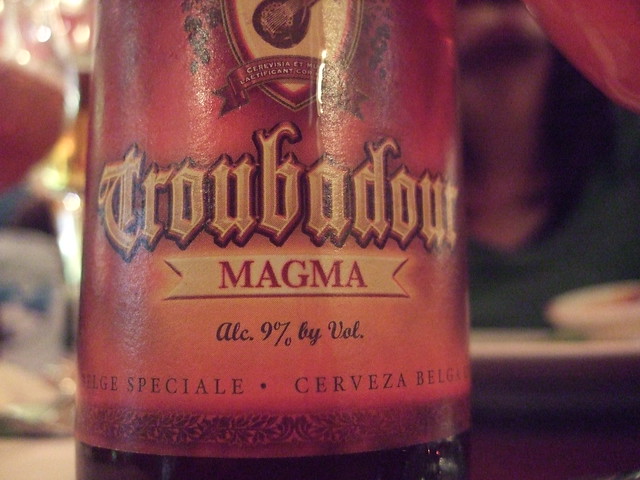
The next evening, we swam hoppier waters and compared the Troubadour Magma 2012 with its basic version.
Nothing says "big beer" like calling it Magma

The basic Magma is somewhat unique in Belgium, where IPAs (let alone Double, Triple or Multiple IPAs) are few and far between. The Musketeers don't label this one as (even a singular) IPA, but it's clear from the get-go that this is what it is. Beautiful orange hazy pour, fruitpunch nose and a solid, luscious, caramelly malt backbone. With a beer like this, you can't go wrong. 

Well, turns out you can: Frank wasn't too happy but face it, Frank's not too hoppy to begin with.

While the Magma is a great beer, I have had little success trying to sell it to less devout beer drinkers than myself, who tend to find the hop aromas and bitterness somewhat overpowering. Being a Hop Head, I think the balance is just right, leaning towards the slightly too sweet, but that's inherent to the style.
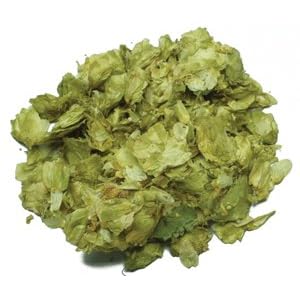
The 2012 version replaces the Simcoe dryhop for this year's(*) new black: Sorachi Ace.


Because a picture of just any old hop will do just fine, right?
Sorachi Ace isn't my favourite hop, being rather weird in flavour and aroma. In this beer, the fruity bitterness of the basic Magma is replaced by a woody, bubblegummy, slightly melony flavour. As expected, Sorachi Ace hints at barrel aging, without actual barrels having been involved. It's definitely a flavour you need to get into; at first it's mildly off-putting, but it does grow on you, and when sampled side-by-side with the basic Simcoe version, it's interesting as well as tasty.

*) you'll note that while Sorachi Ace is 2013's new black, the Magma we're talking about here is the 2012 version. Looks like either the Musketeers are way ahead of the trending market, or they create trends themselves by not giving a damn about them.

For fun (I mean for science!) we ended the session with that gnome of some renown:

Yeah. I get it now. Double tripel equals sextuple. Or how a label can be too clever sometimes.

Amazing how light and refreshing and balanced the Chouffe Houblon is after the more typical sweet undercurrent of both Magmas. Amazing also how much more subtle and refined the little gnome's hop presence is: the Tomahawk/Saaz/Amarillo combo is bold, but delicate, much more so than either one of the Magmas' more bellicose hoppiness. Because the Chouffe is drier, the hops present themselves less as counterweight to the sweetness of the malt, which is where the Magmas get most of their identity. Ironically, at 59 IBU, the Chouffe Houblon is more bitter than the Magmas (the basic version sit at an already impressive 50), but is more aromatic, with less perceived bitterness, than the Magmas.

Very interesting tasting session, which drove home the point what a superbly crafted beer the Chouffe Houblon is. Also, it made me realise once more that what constitutes a tasty beer is different for anyone, and that what makes one person go all "wow" can make the other go "meh" of even "yuck".

After all that hard work, all invested parties slept soundly, if perhaps somewhat too little, and woke feeling much more enlightened (admittedly, enlightenment was struggling for emergence and only prevailed sometime well past noon).

Greetz

Jo